The Rate of Deforestation
How much do you value trees?

I love trees. I can stare at trees like other people can stare at sunsets. Seen from afar, they are like punctuation marks on the horizon. Up close, I love to marvel at their trunks: the curls, nooks and bridges anchoring everything to the ground. They reveal their history from every ridge and bump. Everything was a decision, accumulated over time into the majestic force of nature that stands before you. Every disease fought and won. Every harsh winter survived.
There’s an old idiom in English: “to miss the wood for the trees”, meaning to get lost in the detail you can no longer see the bigger picture. When I was younger, this confused me as I thought the logic of the idiom seemed reversed. I thought the ‘wood’ referred to the substance (i.e. the cellulose fibers and lignin). But, as I now know, ‘wood’ can also mean small forest (old English term ‘wudu’). That makes more sense now!
Cut down
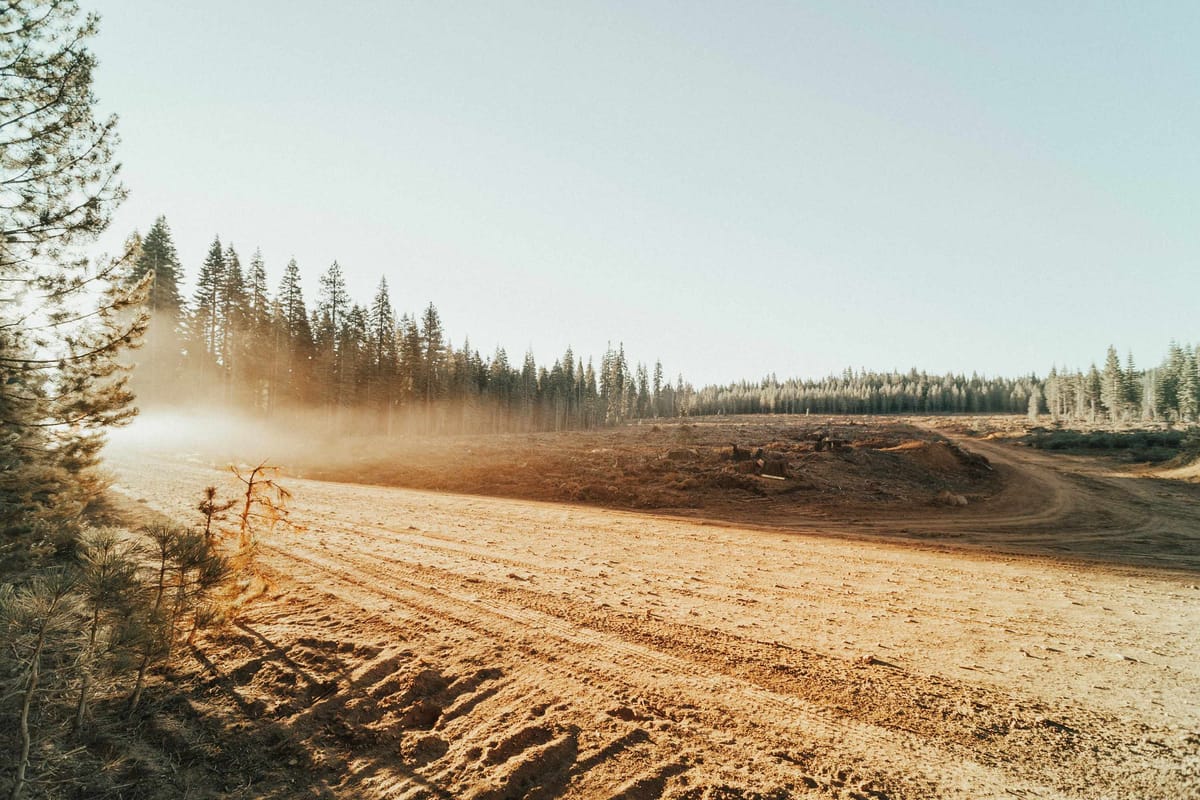
Today, I feel we are definitely missing the wood for the trees. We have completely lost perspective in our narrow focus to support our rapacious appetite for things. We only see trees as commodities, not forest ecosystems. We extract wood to fuel our agricultural and industrial complex without any regard for the broader cost to the natural balance and earth systems we rely on. At the turn of the last ice age, 80% of Europe was covered in a temperate forest. It is now down to 1%.
1%.
Value of a tree
A tree’s offering to the ecosystem around it - from a scientific point of view - has been well established:
- Supporting flora and fauna in and around the tree;
- Building strong mycorrhizal networks beneath the soil;
- Stabilising the landscape against erosion and flooding;
- Regulating the local climate;
- Sequestering carbon and breathing oxygen back into the air.
We know we need to reduce carbon in the atmosphere and a tree is one of the most efficient, natural ways to do this. All you need to do is not disturb a sapling and that oak tree will absorb 25kg of CO2e per year over its lifetime (4 tons over ~200 years). To put that in perspective, a return flight from London to New York costs about 1 ton of CO2e.
You would think that this knowledge would make keeping a tree in the ground a truly valuable thing. There are many programs at the local and government level to encourage everyone to plant more trees. Environmental Impact Assessments (EIA) and Natural Capital Accounting (NCA) attempt to properly value the worth of a tree so that we can make better decisions before cutting them down. You would think that has slowed the rate of extraction down. It hasn’t.
Green to Grey
In the UK, from 2001 to 2024, we lost about 6,000 square kilometers of forest (Global Forest Watch). That’s roughly equivalent to the size of the county of Devon.
The beautiful, wooded Carpathian area in Europe is home to large ancient beech temperate forests and 78,000 hectares are protected as a UNESCO world heritage site. Yet over 7,350 square kilometers have been lost in 20 years (Greenpeace).
While in the vital and vast Amazon, 550,000 square kilometers have been lost over the same period (InfoAmazonia).
Since 2021, forest loss has increased globally despite pledges to protect our green spaces. An area roughly half the size of England was cut down (Forest Declaration Assessment 2025) driven by subsidies for agriculture and other extractive industries. The imbalance between finances devoted to extraction versus conservation continues to grow wider. But the cause is not only logging and deforestation to make way for agriculture…
“Europe is losing green space that once harboured wildlife, captured carbon and supplied food at the rate of 600 football pitches a day, an investigation by the Guardian and partners has revealed. Analysis of satellite imagery across the UK and mainland Europe over a five-year period shows the speed and scale with which green land is turning grey, consumed by tarmac for roads, bricks and mortar for luxury golf courses and housing developments.” - Guardian
The Tesla plant in Germany had to remove half a million trees near Berlin to build their gigafactory. A well-known example of European governments granting permission to the commercial sector to profit from forests and destroy natural green belt whilst paying lip service to protecting nature and climate.
“Private financial institutions are further tipping the balance. A separate report released by Global Witness found that banks have made $26bn from financing deforesting companies since the Paris agreement was signed in 2015 – averaging around $7m every day.” Guardian
While the situation gets worse, governments show no vision or resolve. In September, the EU has again delayed their anti-deforestation law for the second year in a row due to concerns about being ‘anti-industry’ (Politico).
Building hope
We are eagerly awaiting the launch of the The Tropical Forest Forever Facility (TFFF) at COP30 next month. The proposal is to raise a fund of US$ 125 billion in public and private investments to distribute US$ 4 billion each year using performance-based payments at an initial fixed rate of US$4 per hectare of forest per year. But the actual requirement is closer to US$460 billion a year to protect, restore and enhance forests at a global scale (WWF). We are a long way off providing the investment this needs.
So, while national governments prevaricate, what can we do?
Actions
Firstly, if you want to make a meaningful impact, change your diet. The deforestation is largely caused by the agricultural demand to grow animal feed. So, eat less meat.
Secondly, if you need to buy a thing, go to that extra effort to find something made from recycled materials.
Thirdly, if you’re in the UK, back the Climate and Nature Bill (support Zero Hour) which legally requires the UK government to limit deforestation.
Fourthly, plant more trees.
The business of offsetting carbon through planting trees is now well-developed. I personally don’t subscribe to offsetting as a long term strategy: it doesn’t change behaviours. If you want to reduce your carbon footprint, consume and travel less. Paying your debt in trees seems only a short-term fix. It has also resulted in many scams chasing easy, well-intentioned money that does not result in new trees being planted.
Whatever your reason - do it: plant a tree. In your garden. Wherever you can. If you have the money and can sponsor tree planting around the world, here are some platforms that seem to be reputable although I can’t personally vouch for any of them (yet).
- Rewilding in the Scottish Highlands: Trees for Life
- Extending broadleaf woodland across the UK: 9Trees
- Online platforms to support global projects:
Do you know of any others that we can add to the list? Do you have personal experience of any of these platforms directly?
One last recommendation: read ‘The Hidden Life of Trees’ by Peter Wohlleben (ebooks.com). Discovering how little we know about trees blew my mind. It makes protecting these glorious, living beings that much more personal.